Conrad Hubert changed everything in 1898. He invented the first “electric hand torch.” Before that, life was dimmer. Harder. Now, we live in an era of super-bright LEDs and batteries that outlast our patience. Flashlights have shrunk. They have grown smarter. They have also started eating other tools for breakfast.
Enter the 3-in-1 flashlight.
Think of it as the Swiss Army knife of illumination. Victorinox, the name behind the classic Swiss Army knives, actually builds these hybrid beasts. They take their legendary blades and weld them to high-output LED arrays. Dozens of other manufacturers follow suit. They merge utility with light.
Why do makers obsess over this convergence? Simple economics. Power. Convenience.
Decades ago, a flashlight with any serious lumen output was a brick. It cost a fortune. It weighed as much as a hammer. Today, you can buy a light that fits in your palm for the price of a lunch. Manufacturers can cram a drill bit, a pair of scissors, or a tripod mount into a body that still throws a beam bright enough to read by at 3 AM.
For the homeowner, this isn’t just a gimmick. It’s practicality. It’s preparedness. When you’re hunting for a lost screw in a dark basement or cutting a strap during an emergency, having the tool right there with the light saves seconds. Seconds that matter.
But are these hybrids good? Do they perform as well as dedicated tools? We need to look at the combinations. We need to look at the trade-offs. Let’s break down what’s actually available and what works.
The Logic Behind the Merge
The driving force is capability density. You want one tool to do three jobs. It saves space in your toolkit. It reduces the number of pockets you need to carry.
“Where flashlights with any real lighting power used to be bulky and expensive, contemporary flashlights can be tiny yet bright, and very cheap to produce and sell.”
The technology has caught up to the idea. LED efficiency has skyrocketed. Lithium-ion batteries have become dense and safe. This allows engineers to shrink the power source and the light engine, leaving room for mechanical add-ons.
Common 3-in-1 Configurations
Not all multi-tools are created equal. Some prioritize cutting. Some prioritize mounting. Most try to do everything poorly. Here is where the market stands.
1. The Work Light with Clamp and Stand
This is the most practical configuration for home renovation. You get a bright LED head, a folding stand, and a heavy-duty clamp.
- The Light: Usually high-lumen white LEDs. Good for task lighting.
- The Stand: Folds out to create a tripod-like base. Stable on flat surfaces.
- The Clamp: Magnetically or mechanically attached. Grips door frames, table edges, or workbench ledges.
Why it works: You clamp it to a doorframe in a basement. You unfold the stand. You have hands-free lighting for fixing pipes or wiring. No need to hold a flashlight while trying to tighten a bolt.
2. The EDC Light with Knife and Screwdriver

Standard lighting is just the start. You will find a chaotic spectrum of options if you search online. Some units pack three distinct color temperatures into a single housing. Others merge different technologies into one rugged body. The variety is almost overwhelming.
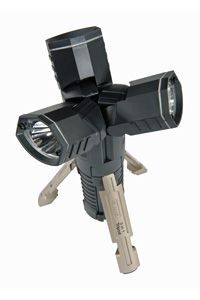
Consider the Stanley Tools 3-in-1 Tripod LED Flashlight. It is not just a light; it is a system. You get three individual flashlights housed in one unit. Use them together for a massive beam. Or detach them to create three separate, smaller lights. The design includes a tripod base and swiveling heads. This makes it highly adaptable for any task. It runs on six AA batteries, which is standard and easy to replace.
Headlights with Specialized Modes
If you need your hands free, look at Energizer’s 6 LED Headlight. It mounts to your forehead but offers more than just generic white light. You get both white and red LEDs. The unit focuses light in three specific modes: spot, flood, and night vision.
Why does this matter? Because context changes your needs. When you are moving through total darkness, a bright white light ruins your night vision. You blink, and everything goes gray. The red LED or night-vision mode solves this. It provides a low red glow that lets you see without blinding yourself. You can cycle through the modes quickly to match the situation.
Hunting and Tracking Specific Lights
Hunters have different requirements. Energizer’s Night Strike is built for them. It is loaded with five different LED types: white, red, blue, ultraviolet, and green. Each color serves a specific purpose in the field.
Green light is ideal for reading maps or tracking game without disturbing their senses. Ultraviolet (UV) light helps you see certain things without scaring away fish. Blue mode changes how you see blood. It makes blood easier to spot in the dark, helping you locate wounded prey faster. It is a tool designed for specific outcomes, not just general visibility.
Safety and Self-Defense Tools
Flashlights provide security. But some products go further into self-defense. The Streetwise 3-in-1 Flashlight Stun Gun is a prime example. It looks like a heavy-duty flashlight. It uses a bright halogen bulb for illumination.
But it is also a deterrent. An ear-shattering 130-decibel alarm is built in. The sound alone might scare off an attacker. If that fails, the stun gun feature engages. It delivers a 600,000-volt shock. Jab an assailant and they get a painful surprise. It is a serious escalation from simple illumination.
Even More Combination Flashlights

Standard single-purpose lights are disappearing. The market is saturated with hybrids that merge multiple lighting technologies into one housing. You can find models pairing LED efficiency with halogen reach. Use the LED for general tasks where battery life matters. Switch to halogen when you need to punch through distance. Some units let you stack LEDs, clicking through modes that engage more bulbs for higher output. Others tack on a high-intensity laser pointer for signaling or aiming.
The combinations get more complex. Manufacturers are putting cold-cathode fluorescent and xenon bulbs into the same tube as LEDs. The LED remains the workhorse for everyday use. The fluorescent bulb casts a wider, softer glow for illuminating a small workbench. The xenon bulb is a power hog. It draws significant current but produces an intense, piercing beam.
Emergency Lighting and Wall-Plug Safety Lights
Power outages happen when it is darkest. Standard flashlights are often buried in drawers or lost. Greenlite’s Nitelight Emergency Light solves this by staying plugged in. It acts as a nightlight during normal operation. When the grid fails, it automatically switches to emergency mode. You get immediate illumination without searching for a device.
If you need more than ambient glow, you can unplug it. It functions as a standard handheld LED flashlight. The design prioritizes accessibility during urgent situations where visibility is near zero. It is a passive safety net that requires no batteries until you take it off the wall.
Credit Card-Sized Multi-Tools
Integration isn’t just about light sources. It is about form factor. Victorinox has embedded lighting into Swiss Army-branded cards. The SwissCard Lite is a prime example. It fits in a wallet. It contains a mini LED light. It also holds scissors, a letter opener, a ball-point pen, screwdrivers, a ruler, a straight pin, and a magnifying glass.
This is not a high-lumen tool. It is a backup light for minor tasks. You carry it everywhere because it takes up no space. If you lose your keys or need to check a gauge in a tight space, the light is always there. It trades raw power for portability and utility.
Car-Specific Safety and Emergency Egress
Vehicle accidents require quick action. Life Gear’s AutoLight addresses roadside emergencies. It uses white LEDs to provide task lighting for changing a tire or inspecting an engine at night. It also features flashing red LEDs. These act as a warning beacon to other drivers. You do not need to set up reflective triangles immediately. The light itself becomes the signal.
The device includes hard emergency features. It has a window spike. This allows you to break safety glass if doors are jammed. There is a seat-belt cutter. This tool helps you escape a wrecked vehicle quickly. It combines illumination with physical egress tools. One device handles visibility and survival.
Glow Sticks and Whistle Hybrids
Life Gear also produces glow sticks with integrated electronics. The 200-Hour Glow Stick uses colored LEDs for long-lasting light. It is not just a static glow. You can switch it to flashlight mode. You can also switch it to an emergency flasher mode.
The critical addition is a built-in whistle. If you are lost or need attention from a distance, sound is as important as light. The whistle is mechanical. It does not require batteries. The light is electronic. You get both signaling methods in one plastic tube. It is useful for camping, hiking, or roadside stops.
The Future of Hybrid Tools
The list of innovative flashlights keeps growing. Technological advances allow engineers to pack more functions into smaller spaces. Materials are lighter. LEDs are brighter. Batteries last longer. This trend will continue.
Whether you are a casual user or a gear collector, these hybrids offer practical value. They save space. They provide redundancy. They handle situations that single-purpose tools cannot. The market is crowded, but the utility is real. You just have to pick the right hybrid for your specific needs.