


The machine drinks too much water. Or not enough.
Maybe it refuses to start the agitate cycle altogether.
Usually, this points to one tiny component.
The water level switch.
It’s a simple pressure sensor.
Water fills the tub. Pressure builds. The switch trips.
Water stops. The cycle begins.
When this little gadget fails, the whole wash routine collapses.
Should you touch it?
Pause.
Check your warranty first.
Most manufacturers offer a hotline. A tech comes out for free.
You break the seal, you void the deal.
If the warranty is gone… consider a pro.
Appliance repair involves electricity. And water.
And sometimes sharp edges you don’t want to think about.
Unplug the machine. Every single time. Before you look at it. Before you think about looking at it.
If you’re DIYing this, power is off. Now it’s safe.
But barely.
Find the culprit
Where is this switch hiding?
Usually under the control console. That panel with all the buttons.
Check the manual if you’re guessing.
Once inside, look for a round switch with a rubber hose attached.
It looks innocent enough.
The hose runs down the side of the tub to the very bottom.
It’s basically a straw.
When water enters the bottom, air gets trapped above it. Pressure rises.
That pressure triggers the electrical contacts.
No pressure. No trigger. No stop signal.
Infinite fill. Or no fill.
Depends on which way it breaks.
The Tube: Dirty or Kinked?
Before you judge the electronics, check the plumbing.
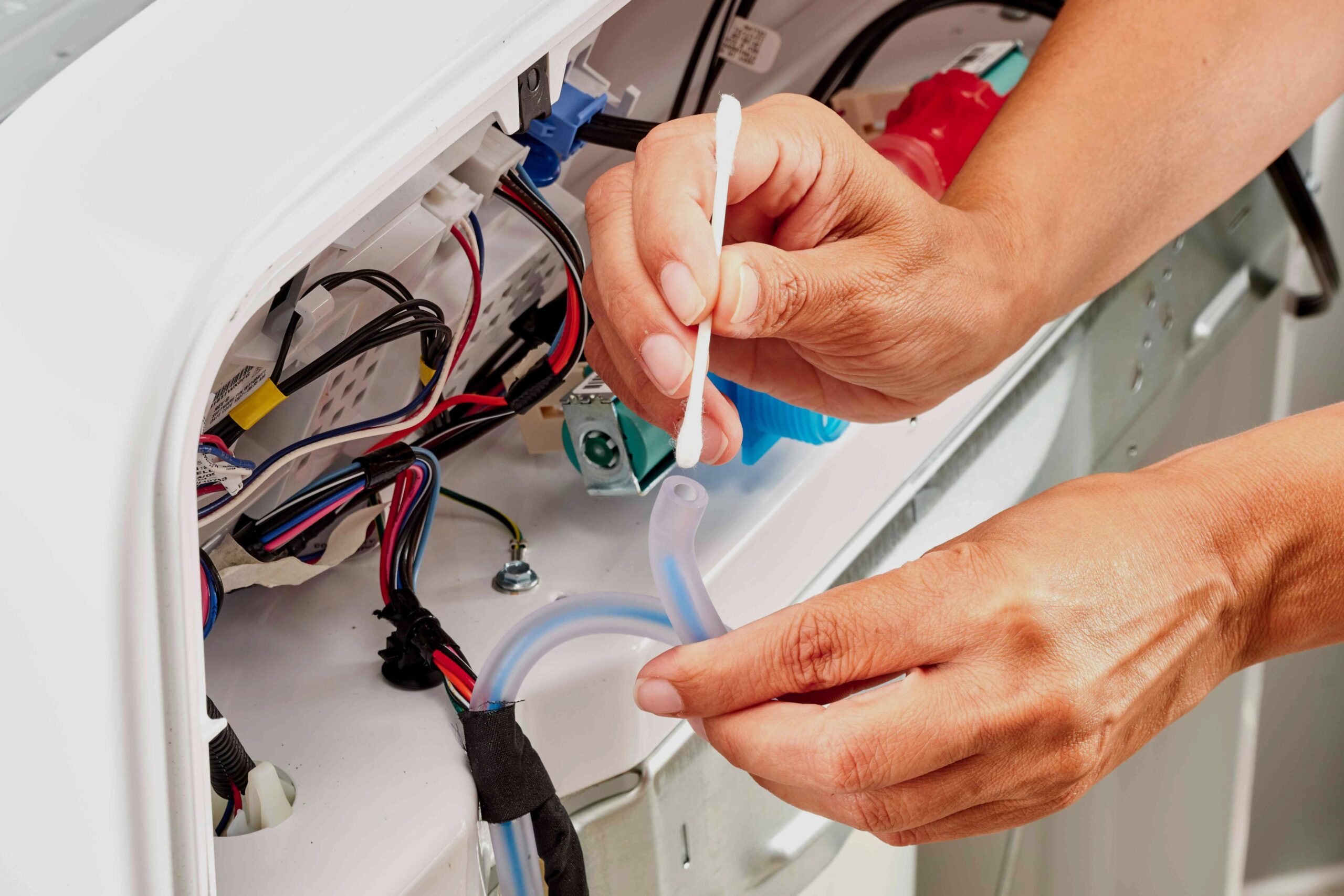
Inspect that rubber hose.
Disconnect it at both ends. Loosen the clamps.
Pull it off.
Look inside.
Is there sludge? Sediment? Water pooling in there like a swamp?
That’s a blockage.
Blow through it. If nothing happens, clear the gunk.
A strong blast of compressed air or a thorough soak works wonders.
Maybe that was the whole problem.
Don’t skip this.
If the hose is kinked, straighten it. If it has a hole, replace it.
A clean, open hose is non-negotiable.
The Electrical Test
Assume the tube is clear. Now assume the brain is fried.
Time for a multimeter.
Set it to the OHMS scale (lowest setting).
Find the switch terminals. Usually, there are three wires connected.
Unplug them.
If they are clipped in, pop them out. If they are twisted on, label the wires so you don’t mix them up. Confusion now leads to broken machines later.
Here’s the dance:
Touch the probes to Terminal 1 and Terminal 2. Note the reading.
Touch 1 and 3. Note it.
Touch 2 and 3. Note that one too.
Normal results:
– Two pairs will read infinity (no connection).
– One pair will read zero (a closed circuit).
If both are infinite? Or all zero? The switch is dead.
Throw it away.
If it reads right? Keep reading.
This isn’t the whole picture yet.
Reconnect the pressure hose to the switch side.
Leave the tub side disconnected.
Blow into the hose gently.
Do it.
Listen for a click.
You should feel the resistance change in your mouth as the pressure builds.
Now, retest the terminals while holding that air pressure. (Pinch the hose to keep it sealed).
Watch the numbers.
The pairs that were open (infinity) before should now be closed (zero).
The pair that was closed before should now be open.
They flip-flop.
If they don’t switch when you add pressure, the internal mechanism is broken.
New switch time.
If they do switch perfectly… the electronics are fine.
Reattach the hose to the bottom of the tub firmly.
Plug the washer in.
Run a cycle.
Does it fix the overflow?
Probably.
Unless the timer is broken too. Or the inlet valve is stuck.
There are always more parts to break.
But start with the pressure switch. It’s the most common liar. 🌊