

The old awning is dead. Long live the canisse.
If your fabric shade still rattles on its slats and the mechanism jams every time you try to roll it up, let it go. It’s July. The sun is hammering your south-facing windows, turning your glass into giant radiators. You need cooling, fast. But there’s a shift happening in construction and landscaping circles. Masons and gardeners are installing something older before they even mention motorized fabric.
It’s not an aesthetic whim. It’s a math problem. Cheaper. Faster to install. Far more effective at blocking heat. And it fits the current trend of using natural materials outdoors.
This isn’t about style points. It’s about survival in the heat.
Canisse is Dethroning the Awning on South-Facing Walls
On terraces and walls bathed in relentless sun, canisse (woven reed or bamboo screen) is becoming the default solution. It’s discreet. It’s surprisingly tough.
Made from woven stems of bamboo, reed, or heather, canisse filters light while letting air pass through. Synthetic stretched fabrics trap heat. They create an oven effect. Canisse breathes.
Its main advantage? It’s a natural sunshade. In front of a south-facing sliding door, it drops the interior temperature noticeably without plunging the room into darkness.
Masons prefer it for pragmatic reasons. No motor. No housing box. No articulated arms. That means no mechanical failure after three summers. The cost is negligible compared to a motorized awning. You’re looking at a few dozen euros to cover a significant surface area.
How to Install Canisse Before a Glass Door or Terrace
Installation depends on your façade.
For glass doors, you don’t stick it to the pane. You build a light frame—aluminum or wood—behind which the canisse sits. Keep it a few centimeters away from the glass. This air gap is non-negotiable. It dissipates heat instead of trapping it against the window.
For a terrace or plain wall, the method is more direct. Here is the standard workflow:
- Fix vertical slats or a light pergola structure facing the zone to protect.
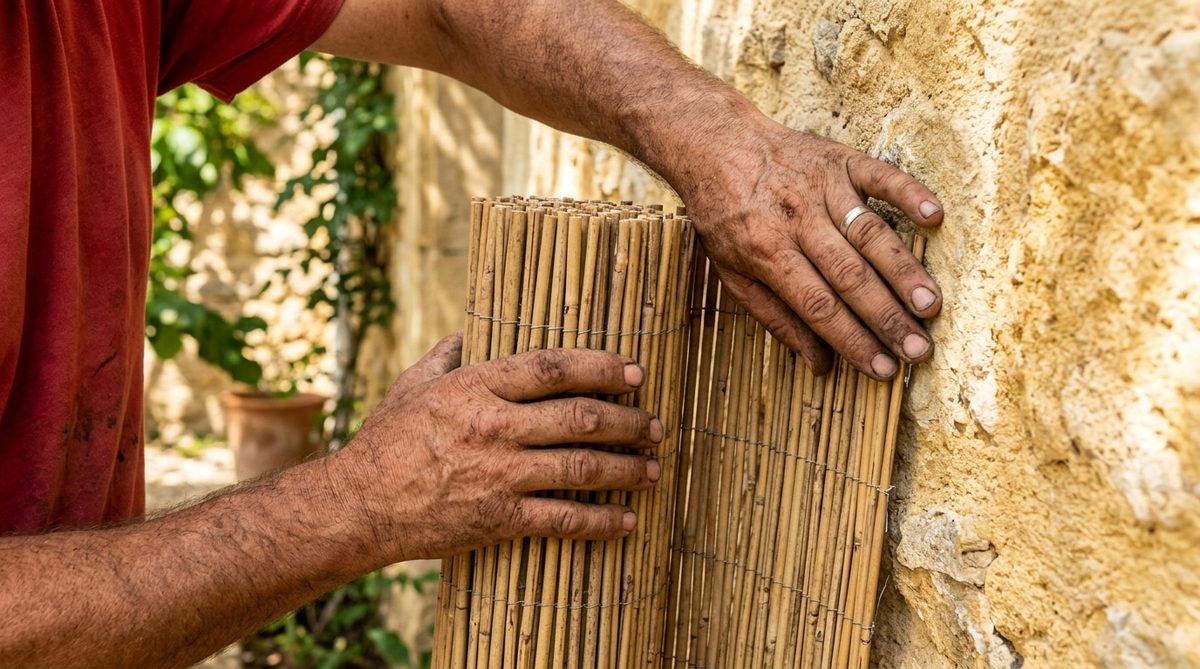
- Unroll the canisse, keeping it taut.
- Secure it with galvanized wire or UV-resistant cable ties.
- Reinforce the ends. Wind frays edges quickly.
A standard roll is usually 1.5 or 2 meters high, spanning 3 to 5 meters long. You can cover a large area in a single morning.
Mistakes to Avoid and Habits for Longevity
The biggest mistake? Pressing the canisse directly against the glass or wall.
Without ventilation space, humidity builds up. Heat stays trapped. You must leave room for air to circulate. Ideally, maintain a 5 to 10 cm gap.
Second pitfall: weak upper fixings. A poorly tied canisse becomes a sail in the first summer storm gust. More attachment points are better than fewer.
Choose your material wisely. Bamboo lasts well. Heather offers a denser, more opaque look. Reed is the cheapest option but also the most fragile against repeated bad weather.
Treat the stems with linseed oil at the start of the season. It extends life significantly and restores that nice golden hue.
What to Remember Before Trading Your Awning for Canisse
Canisse checks every box for today’s priorities: eco-friendly, economical, aesthetic, and effective. It works with a contemporary house or a stone Southern French cottage. It pairs well with pergolas, trellises, or climbing plants like star jasmine.
Its only real flaw? It’s not retractable. Unlike a fabric awning, it stays up all season.
For many, this fixed, maintenance-free nature is exactly the charm.
As we look for ways to cool homes without cranking up the AC, this simple, almost Mediterranean gesture makes sense. Canisse isn’t a passing fad. It’s a return to common sense for façades that know how to protect themselves. You just need to pick the material that fits your outdoor spirit.
It’s not about perfection. It’s about staying cool without the headache.
Key takeaways:
- Canisse is replacing awnings on many south-facing façades.
- It cools naturally through air circulation between stems.
- Installation is quick, cheap, and requires no motorization.
- Bamboo, reed, and heather each offer different durability and looks.
- Ventilation space and strong fixings are essential.
- Minimal maintenance with linseed oil extends its lifespan.
The sun doesn’t wait. Neither should your fix.