




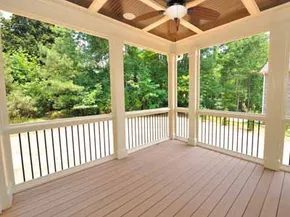
Deciding how to build a deck used to be straightforward. Wood or wood? That was the debate. Today, the aisle is crowded with options that don’t contain a single gram of timber. Why the explosion of choices? It’s the same human urge that drives every other industry: make it easier. Make it last. Make it convenient.
Real wood demands attention. Whether you’re using pressure-treated pine, redwood, or cedar, you’re signing up for a relationship. Sanding. Staining. Resealing. It’s an annual chore for some, others get lazy and stretch it to two or three years. The wood rots anyway.
Enter the entrepreneurs. They saw homeowners sweating over pressure washers and decided to sell them a break. Vinyl. Aluminum. Even pure plastic. But the biggest shift in the game is composite decking.
What Is Composite Decking Made Of?
Composite decking looks like wood. It feels like wood. But underneath, it’s a science experiment.
Manufacturers take wood byproducts—sawdust, wood chips, fiber—and mix them with plastic. Virgin or recycled. Doesn’t matter. They add pigment. Add preservative. Heat it up. Form it into board shapes. Cool it down.
The result? Heavier than wood. Not as strong.
But here’s the trade-off. It doesn’t rot. It doesn’t warp. It won’t splinter. You don’t paint it. You don’t stain it. You don’t seal it.
Color will fade a bit after installation. That’s normal. Keep it swept clean. Spot-treat stains immediately. Hose it down twice a year. A quick scrub with soap and water keeps it looking sharp.
Solid vs. Hollow Composite Decking
If you’re trying to decide between solid and hollow composite decking, here’s the breakdown.
Solid decking looks like real wood. It’s heavier. Because of that mass, it expands and contracts more when temperatures swing. It’s the popular choice for a reason. Superior strength. Better aesthetic.
Hollow decking looks more artificial. It’s lighter. It resists expansion and contraction better. But it’s fragile during installation. Drop it? Crack it. Be careful.
“Even though the wood fibers and other cellulose in the decking have been combined with plastic, it can still rot, according to the Forest Products Journal.”
This is the catch. Most composites are at least 40% wood. Some are up to 70%. Wood rots. Moisture accelerates rot. That’s why the preservative matters.
It’s mixed in during manufacturing. Some preservatives, like zinc borate, stay active for over 20 years. Without it? Serious problems. Excessive moisture finds those wood fibers. It wins.
A Warning on Quality and Recalls
Not all composite decking is created equal. Or safe.
In 2005, the U.S. Consumer Product Safety Commission (CPSC) issued a recall. Kandant Composites Inc. made decking that was breaking. Why? Exposure to hot temperatures and sunlight degraded the material.
The CPSC had specific instructions for homeowners. Check for visible cracks. Scrub the surface with a fingernail or the corner of a credit card. If it scratches easily? You’ve got a problem.
Kandant is out of business now. But the lesson remains. Quality varies. Inspect your materials.
Head over to the next page to read about the different types of composite decking.
Choosing the Right Composite Decking Material
You are looking at a shifting landscape. The industry is moving away from older polyethylene-based composites. The focus is now on polypropylene-based products or nonwood plastics like polyvinyl chloride (PVC)-based materials. Why the switch? Polypropylene boards are typically stronger. They resist expansion and compression better than their predecessors.
These newer plastics contain zero wood content. That means they do not stain. They do not absorb water. Manufacturers are using advanced tech to mimic the look and feel of real wood. It is close enough for most homeowners.
Cost is a major factor. Composite decking costs more than wood. How much more depends on the brand. Nonwood plastics are significantly more expensive than real wood. They are lighter than other composites. They usually contain no recycled content.
Color, texture, location, and usage narrow down the best product. You need a surface that fits your climate and your lifestyle.
Big names dominate the market. ChoiceDek, EON, Epoch Evergrain, GeoDeck, LP Weatherbest, TimberTech, Trex, and Veranda are key players. The industry is trying to eliminate the old issues. Staining. Fading. Mold. Here is what some of these specific products offer.
Product Breakdown
- CorrectDeck : Made from hardwood fiber and polypropylene. Eighty percent of its content is reclaimed or recycled. The CX line features a top layer of polypropylene with antimicrobial protection. It resists mold and mildew.
- Cross Timbers : Combines oak and polypropylene. You get a stronger board. It can span 24 inches on center. That is further than most composite decking allows.
- GeoDeck Tongue & Groove : Contains cellulose with lower lignin levels. This makes the product fade-resistant.
- Veranda : Offers a different combed finish on each side of the board. You get two looks in one product.
- EON : Is 100 percent plastic. Manufacturers use ultraviolet light inhibitors to eliminate fading. A T-clip fastens the decking. No nails or screws. The finish is clean.
- Epoch Evergrain : Uses compression molding. This gives it a deep grain. It looks more like wood than other compression decking options.
- ChoiceDek : Combines polyethylene and recycled wood. A ribbed design makes it lighter and stiffer. It allows more air circulation between the decking and framing.
- Latitudes Composite Decking : Uses a hidden fastener system. It automatically spaces boards with the proper gap. Installation is easy.
Check building requirements at www.Decks.com. They maintain a list of approved decking materials. Visit the site for further information.
Building a Composite Deck
Materials cost more. Installation costs are comparable to wood. You still use a pressure-treated wood foundation. But the installation details differ significantly.
There is a plastic lumber option. USPL’s TriMax can be used for structural applications. Be careful. Unless you oversize the joists or space them closer, the deck will be bouncy.
Manufacturer specifications dictate the gaps. You need gaps between boards. You need gaps between the decking and abutting walls. These gaps accommodate the expansion and compression inherent in composite decking.
Calculate fasteners by multiplying the number of joists by the number of decking boards.
Composite decking is weaker than wood. If you install it on a foundation built for wood, you will need more joists. Adjust the framing if you are using a pattern. Herringbone. Tile pattern. These require structural changes.
Drainage and airflow are crucial. They keep the decking from degrading. If you are installing over a solid surface, build a sleeper system. Pitch the surface below for drainage. Or outfit it with a gutter system. TimberTech’s DrySpace Drainage System drains water from underneath.
The type of decking dictates parts of the installation. Hollow decking requires a picture frame design or a starter strip. The strip covers the end of the first piece. It hides the fact that the board is not solid. Hollow decking also needs a screw at every junction where a joist meets the decking board.
One final note. Most manufacturers offer warranties. The warranty is void if installation does not follow directions precisely. A bad installation results in a degraded, unsafe deck.
To learn more, visit manufacturer sites.
Maintenance Reality
Once it is done, it is done. You cannot refinish composite decking like you can with wood.
Be careful with paint. Grease. Red wine. Take care of spills immediately. Avoid permanent staining. Use only white chalk for marking. Colored chalk will leave a mark you cannot remove.
Where to dig deeper into outdoor materials
The research trail doesn’t end with the final board laid. If you are standing in your backyard wondering if you made the right call, or if you just want to understand the science behind why your new deck doesn’t rot like the old pine one did, the rabbit hole goes deep. You are not alone in wanting to know how these materials are actually made or where they might fail.
Several sources back up the shift away from traditional timber. Tim Carter at Ask the Builder has long debated the merits of composite decking, breaking down why wood-grain textures on plastic boards can be both a selling point and a liability. He points out that maintenance is the primary driver for homeowners to switch, but the upfront cost still gives people pause.
Then there is the safety angle. You cannot ignore the recalls. The Consumer Product Safety Commission and Kadant Composites Inc. issued alerts regarding GeoDeck railing materials. It is a stark reminder that even synthetic materials can have structural weaknesses if manufacturing tolerances slip. When you buy a kit, check the recall lists. It saves you from having to tear out a railing three years later because a bracket snapped under pressure.
Understanding the alternatives
Why does a flooded house need to be torn down? You might ask that when you see water damage in your basement. It is a related anxiety. Water is the enemy of wood. It is less of an enemy to high-quality composite decking, which is why it survives those floods with minimal fuss. But it is not immune to everything.
Mike Descoteaux from CorrectDeck explained that the key is in the polymer blend. If the plastic is too soft, it warps in the summer heat. If it is too hard, it becomes brittle in winter. The “smooth choice” mentioned by Rob Jones in Amazines refers to how modern extrusions reduce splinters and rough edges, making barefoot walking safer. This is a practical benefit for families with young children who spend more time on the deck than you might expect.
Margaret Montenegro at DoItYourself.com highlights that this is a trend, not a fad. People are tired of staining. They are tired of the annual chore of sealing wood against the elements. The wood deck alternatives discussed by Benjamin Hardy on Bob Vila range from PVC to cap-and-core composites. Each has a different price point and durability profile.
The manufacturing reality
How is ceramic tile made? It is a good comparison. The kiln firing process makes it dense and waterproof. Composite decking uses a similar logic but with polymers. The Integrity Block mentioned in related industry articles is a specific type of structural component that helps with load-bearing, proving that innovation is happening in the hardware, not just the surface boards.
The sources from 2008 might feel dated now, but the fundamental chemistry hasn’t changed. The debate between natural wood and engineered composites continues. You still need to check for UV resistance. You still need to ensure your sub-frame is level. But the choice itself has become simpler.
If you are looking for more on the technical side, check out the guides on daylighting devices. You might not be installing a skylight, but understanding how light interacts with your new surface helps in planning the layout. And if you are curious about the origins, the pieces on How Skylights Work reveal that transparency and