

Even the best steel dulls eventually. Inexpensive knives and scissors are usually not too sharp to start with. You need to keep fine steels sharp. Salvage dulled blades with periodic honing. This takes about 15 minutes to half an hour.
Tools and Materials
You will need these items:
- Whetstone
- Deep pan
- Fine-grit silicon carbide slipstone
- Sharpening steel
- Screwdriver or hammer
- Household or light machine oil
- Soft cloths
- Mineral spirits
- Box with lid or sealable plastic bag
Preparing the Whetstone
Buy a whetstone with one coarse and one fine side. To prepare the stone for use, put it in a deep pan. Cover it with household or light machine oil. Let it soak overnight.
Remove any dirt or loose particles with a soft cloth soaked in mineral spirits. Between uses, store the prepared whetstone in a box with a lid or a sealable plastic bag.
Sharpening Knives
To sharpen a very dull knife, use first the coarse and then the fine side of the whetstone. To sharpen a blade in better shape, use only the fine side. Have badly chipped or serrated knives professionally sharpened.
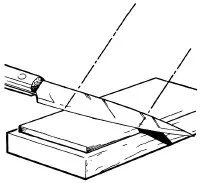
Oil the surface of the whetstone lightly. If you can see the cutting bevel on the knife blade, keep the knife at this bevel as you work. Otherwise, hold the knife with the blade at a 30-degree angle to the stone.
“Holding the knife blade firmly at the bevel angle, push the full length of the blade gently but firmly away from you, at a diagonal across the stone.”
Lift the knife blade at the end of the stroke. Turn the knife over. Repeat, stroking the blade away from yourself across the stone. Repeat, using alternating strokes on the two sides of the blade, for the same number of strokes on each side. These alternating strokes remove any tiny burrs caused by the sharpening.
For very dull blades, follow this sharpening procedure on first the coarse side and then the fine side of the stone. Remove debris from the knife blade with a soft cloth.
Stainless steel doesn’t care about your whetstone. It demands silicon carbide.
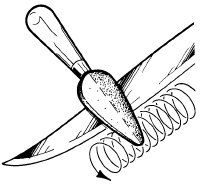
If you’re working on fine carving knives, skip the standard stone. Grab a fine-grit silicon carbide slipstone. The grit is different. The result is cleaner.
Hold the slipstone at the proper bevel angle. This is the hard part. You need consistency. Use tight circular passes. Don’t just drag it across. Circle the stone. Cover the whole edge.
Whet both sides. Alternately. Left, right, left. This keeps the cutting edge even. If you only sharpen one side, you’ll get a hooked edge. You don’t want that.
Touching Up with a Sharpening Steel
Sometimes you don’t need a stone. You need a steel.
A sharpening steel realigns the edge. It doesn’t remove much metal. It fixes the microscopic bends that happen after a few uses.
Stand the steel tip-down on a towel. Or hold it firmly in your non-dominant hand. Blade away from you.
Pull the knife down. Lightly. The edge meets the steel. Stroke the entire length. Handle to tip. Do this on one side. Then the other.
Six strokes per side. That’s usually enough. More than that and you’re just wearing down the steel.
A dull knife is a dangerous knife. A sharp one is an extension of your hand.
Sharpening Scissors on a Whetstone
Scissors are trickier. They have two blades. They have a pivot.
Use a lightly oiled whetstone. Oil prevents clogging. It also gives you a feel for the stone.
Open the scissors wide. Flat. Set the outside beveled face on the stone. Angle it back slightly. Diagonal.
Stroke away from you. Handle to tip. Firm, but gentle. Lift at the end. Don’t drag it back.
Sharpen one blade. Then the other. Only the beveled side. Don’t touch the flat inner surfaces. You’ll ruin the fit.
Wipe them clean. Test the cut.
Open and close the scissors. The blades should touch lightly. All along the edge. If they catch, the tension is off.
Too tight? Loosen the pivot screw. Half a turn. Test again.
Too loose? Tighten it.
Some scissors use a rivet. No screw. Tap the rivet lightly with a hammer. It spreads the metal. Tightens the fit.
Don’t try this with pinking shears. The zigzag edge is a nightmare. Take them to a pro.
Kitchen Improvement Resources
You’ve got your tools sharp. Now what?
If you’re looking to upgrade the space itself, the materials matter.
- Design: Start with the layout. How to Design a Kitchen gives you the blueprint.
- Materials: Wood, stone, metal. A Guide to Kitchen Remodeling Materials breaks down the options.
- Improvements: Small changes. Big impact. How to Build Kitchen Improvements covers the quick wins.
The edge is sharp. The scissors cut true. The kitchen is ready.